Ceramic Coating vs Wax: Which Is Better for Houston Heat? | On The Go Mobile Detailers

Paint Protection Guide · Houston TX

Ceramic Coating vs Wax:
Which Wins in
Houston Heat?

📅 May 2026 ⏱ 8 min read 📍 Houston & Katy, TX

Your car's paint is under attack every day — UV rays, humidity, road grime. The right protection makes the difference between a showroom shine and faded, oxidized paint.

See the Full Comparison ↓

Two Protection Options, Very Different Results

If you live in Houston or Katy, TX, you already know: the heat here is no joke. Summers push well past 95°F for weeks at a time, UV index levels rank among the highest in the country, and the humidity creates its own set of paint problems. The question every car owner eventually faces is — wax or ceramic coating?

Both protect your car's paint. But they do it very differently, at very different price points, and with very different lifespans — especially in an extreme climate like Greater Houston. According to Consumer Reports' car care research, paint protection is one of the most overlooked maintenance categories, yet it has a direct impact on resale value and long-term appearance.

In this guide, we break down exactly how each option performs — and which one makes more sense for your vehicle, your budget, and Houston's climate.

Traditional

Car Wax

A natural or synthetic compound applied to the paint surface to add gloss and a basic layer of protection. Wax has been the go-to for decades — affordable, easy to apply at home, and delivers a warm, glossy finish. But it breaks down fast under heat and UV exposure.

Advanced

Ceramic Coating

A liquid polymer that chemically bonds to your vehicle's clear coat, forming a hard, semi-permanent protective layer. It's hydrophobic, UV resistant, and far more durable than any wax product. Professional application ensures a flawless, long-lasting result.

What Exactly Is Car Wax?

Car wax comes in three main forms: paste wax, liquid wax, and spray wax. At its core, wax creates a thin, sacrificial layer on top of your vehicle's clear coat. That layer fills in minor surface imperfections, adds depth to the paint color, and temporarily shields against light contamination like bird droppings, water spots, and road dust.

The most popular traditional choice is carnauba wax — derived from Brazilian palm leaves. It produces a warm, deep shine that many enthusiasts still prefer aesthetically. However, its weakness is well-documented: carnauba melts at around 180°F, and car surfaces in Houston can easily reach 140–160°F on a sunny summer day.

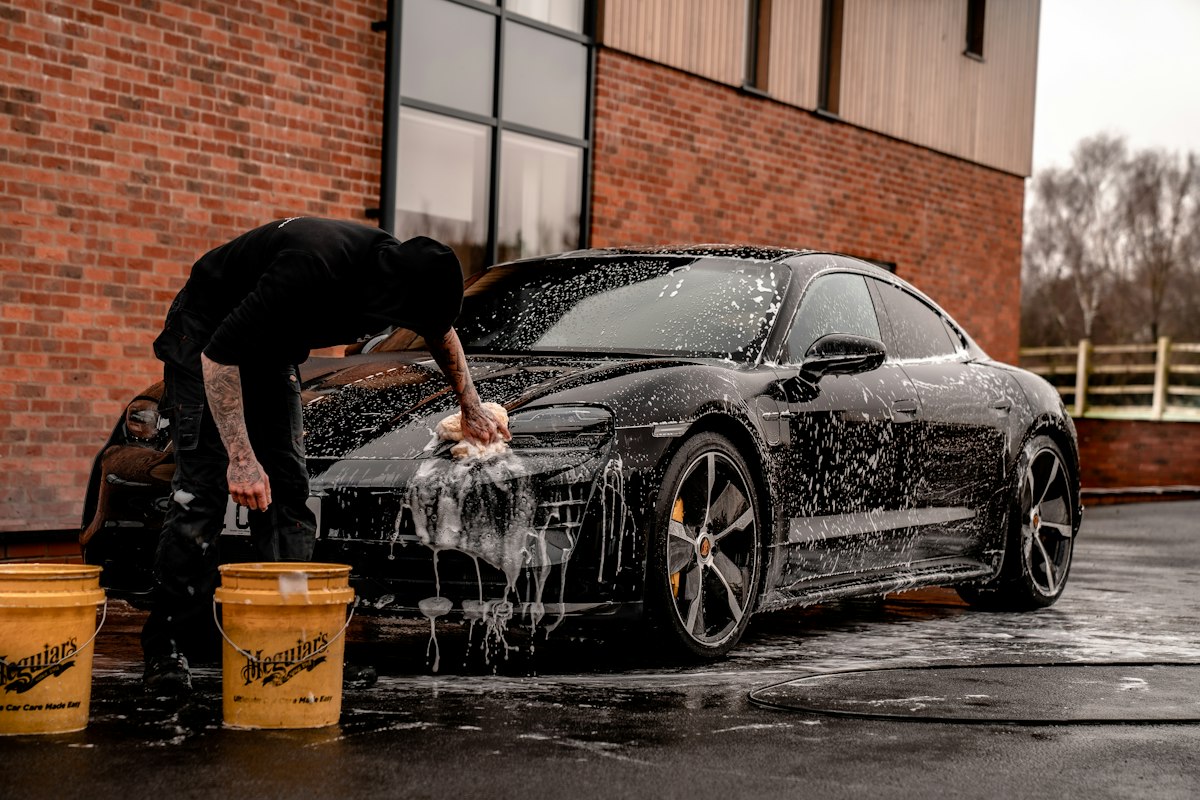
Professional applying car wax to vehicle paint surface

Traditional wax application delivers shine, but the results are temporary — especially in Texas heat.

⚠ Houston Heat Factor — Wax

In climates like Houston's, paste wax needs to be reapplied every 4 to 8 weeks. In peak summer, UV degradation and heat can break down the wax layer even faster. Synthetic polymer sealants perform better (up to 6 months), but still pale against ceramic in longevity and heat resistance.

Wax is also water-soluble, which means that Houston's heavy rainfalls — we average over 49 inches of rain per year — will wash it away more quickly than in drier climates. The combination of UV, heat, and rain makes wax a constant maintenance battle in the Gulf Coast region.

What Is Ceramic Coating — Really?

Ceramic coating is a liquid nanotechnology product — typically silicon dioxide (SiO2) based — that, when applied correctly, forms a covalent bond with your car's factory clear coat. It doesn't sit on top of the paint like wax; it becomes part of it, creating a glass-like hardness layer (rated on the 9H pencil hardness scale in quality products).

The result is a surface that is hydrophobic (water beads and rolls off), UV resistant, chemical resistant, and self-cleaning by nature. Dirt, grime, and road contaminants have a much harder time bonding to a ceramic-coated surface.

This technology was originally developed for industrial use — protecting aircraft, marine vessels, and high-end machinery from environmental damage. It's now accessible for consumer vehicles, and the Car and Driver's ceramic coating explainer is a great reference for understanding how the chemistry works at a deeper level.

Ceramic coating being applied to car paint by a professional detailer in Houston

Ceramic coating forms a chemical bond with the clear coat — creating a hard, hydrophobic shield that lasts years.

"A properly applied ceramic coating doesn't just protect paint — it fundamentally changes the surface chemistry of your car. Water, UV, and chemical contamination interact completely differently with a coated vehicle." — Professional Detailing Industry Standard, IUPAC Research Notes

The professional ceramic application process:

1

Full paint decontamination

The vehicle is washed, clayed, and chemically decontaminated to remove all bonded surface contaminants before any coating touches the paint.

2

Paint correction (if needed)

Swirls, scratches, and oxidation are corrected with machine polishing. Our professional buffing and polishing service in Houston ensures a flawless base before any coating is applied.

3

Panel wipe / surface preparation

Panels are cleaned with an IPA (isopropyl alcohol) solution to remove all residual oils and polish lubricants for maximum coating adhesion.

4

Ceramic coating application

The coating is applied panel by panel using a specialized applicator block and suede cloth, leveled before it fully cures.

5

Cure time & inspection

The coating cures over 24–72 hours. During this time the vehicle should stay dry. A final inspection under specialized lighting confirms even coverage and no high spots.

Side-by-Side Comparison

Factor 🟡 Car Wax 🔵 Ceramic Coating
Lifespan 4 – 8 weeks (carnauba)
3 – 6 months (sealant)
2 – 5 years (professional grade)
UV Protection Low — degrades rapidly in sun High — UV-blocking nano layer
Heat Resistance Poor — melts above ~180°F surface Excellent — stable to 1,200°F+
Hydrophobic Effect Moderate — water sheets off initially Superior — extreme beading effect
Scratch Resistance None — soft wax layer Good — 9H hardness rating
Chemical Resistance Low — stripped by car wash soaps High — pH neutral and acidic resistant
Gloss / Depth Warm, deep — popular aesthetically Wet, glass-like — extreme clarity
DIY Friendly Yes — paste wax is simple Not recommended — high-spots without prep
Cost $15 – $50 per product $400 – $1,500+ professional install
Cost Per Year $100 – $300+ (products + labor) $100 – $300 averaged over 5 yrs
Houston Suitability Poor — frequent reapplication Excellent — built for extreme climates

Protection Performance in Extreme Heat

Numbers don't lie. Here's how both options score across the key protection categories that matter most in Houston's climate — UV resistance, hydrophobic longevity, chemical resistance, and ease of maintenance.

Performance Comparison (100 = best possible)

🟡 Car Wax

UV Protection28/100
Heat Resistance18/100
Hydrophobic Effect40/100
Durability15/100
Chemical Resistance22/100

🔵 Ceramic Coating

UV Protection92/100
Heat Resistance97/100
Hydrophobic Effect95/100
Durability94/100
Chemical Resistance88/100

Why Houston's Climate Changes Everything

Houston sits in USDA Hardiness Zone 9a–9b, and summer UV index readings regularly hit 10–11 (out of a maximum of 11+). This isn't just uncomfortable — it's actively damaging to unprotected automotive paint. Clear coat oxidation, paint fading, and loss of gloss depth are all accelerated dramatically in this environment compared to, say, a car kept in Seattle or Minneapolis.

Let's put the numbers in context for Houston specifically:

Houston Climate Statistics — Paint Protection Context

📊 Average summer high: 94°F — vehicle surface temps can reach 150–160°F in direct sun

☀️ UV Index average (June–Sept): 9–11 — "Very High" to "Extreme" every day

🌧 Annual rainfall: ~49.8 inches — one of the wettest major US cities

💧 Relative humidity: 74–90% in summer — accelerates chemical reactions on unprotected paint

🧪 Acid rain risk: Moderate in Southeast Texas — especially near petrochemical corridors

The combination of extreme UV, high humidity, acid rain exposure, and road salt near coastal areas means Houston paint is under constant multi-vector attack. A standard carnauba wax — even a premium product — simply isn't engineered to withstand this. You'd be reapplying every 4–6 weeks just to maintain basic protection.

Ceramic coating, by contrast, was developed for exactly these kinds of industrial and environmental extremes. Its SiO2 matrix is chemically inert to the UV spectrum and hydrolytically stable — which is a technical way of saying it doesn't break down when exposed to water and heat repeatedly, the way wax does.

Houston Texas skyline on a hot summer day — UV protection for vehicles is critical

Houston's summer UV levels rank among the most intense in the continental US — making ceramic coating the logical choice.

Which One Should You Choose?

The honest answer depends on your situation — budget, how long you plan to keep the vehicle, and how much maintenance you're willing to do. Here's a straightforward breakdown:

🟡 Choose Wax If...

  • You have a budget under $50 and prefer DIY maintenance
  • The vehicle is older and resale value isn't a priority
  • You plan to sell the car within the next 6 months
  • You enjoy detailing as a weekend hobby and don't mind reapplying regularly
  • You want a warm, traditional gloss aesthetic on a show car that's garaged most of the time

🔵 Choose Ceramic If...

  • You park outdoors in Houston sun daily
  • You drive 15,000+ miles per year — exposure is constant
  • You want to protect resale value over 2–5 years
  • You drive a luxury, performance, or newer vehicle
  • You want set-it-and-forget-it protection without frequent reapplication
  • You're a rideshare or fleet driver who needs low-maintenance appearance
For the vast majority of Houston drivers who park outside, commute year-round, and want their car to look great without constant maintenance — ceramic coating isn't just the better option. It's the only practical long-term choice for this climate. — On The Go Mobile Detailers, Houston & Katy TX

One important note: ceramic coating locks in whatever condition your paint is in when it's applied. If your clear coat has swirl marks, light scratches, or oxidation, they'll be sealed under the coating. That's why professional paint correction before coating is not optional — it's essential. Our team performs complete paint correction and buffing and polishing in Houston before every ceramic coating job to ensure you're sealing perfect paint, not defects.

Ready to Protect Your Car from
Houston Heat?

We come to your home or workplace — no shop visit needed. Mobile ceramic coating and paint correction across Houston and Katy, TX.

Frequently Asked Questions

Yes — emphatically. Houston's UV index, ambient temperatures, and humidity make ceramic coating significantly more cost-effective than wax when you factor in the reapplication cycle. A professional coating lasts 2–5 years while wax needs to be redone every 4–8 weeks. Over 3 years, ceramic coating often costs less than ongoing wax maintenance when labor is considered.
A standard paste or carnauba wax in Houston's climate will typically last 4 to 8 weeks before significant degradation. In peak summer — June through September — the combination of extreme UV and high surface temperatures can shorten that to 3–5 weeks. Synthetic polymer sealants perform better (3–6 months) but still require much more frequent reapplication than ceramic coating.
No. Wax residue on the paint surface will prevent the ceramic coating from properly bonding with the clear coat. Before any ceramic application, the vehicle must be thoroughly decontaminated and wipe-down with an IPA (isopropyl alcohol) solution to ensure all oils, waxes, and sealants are removed. Skipping this step results in uneven coverage, high spots, and premature coating failure.
Ceramic coating adds hardness (typically rated 9H on the pencil hardness scale) that provides resistance to light scratches, swirl marks from washing, and minor abrasions. However, it is not scratch-proof. Deep key scratches, gravel impacts at high speed, or pressure washing at close range can still damage the coating. Think of it as significantly improving scratch resistance, not eliminating scratch risk entirely.
Professional ceramic coating in the Houston and Katy area ranges from $400 to $1,500+ depending on vehicle size, paint condition (whether correction is needed), and the specific product grade used. Consumer-grade DIY kits exist in the $50–$150 range but require significant prep skill and are not recommended for most car owners. A professional application from a mobile detailer includes all prep work and comes to your location.
Ceramic coated vehicles are significantly lower maintenance than waxed cars. Wash with a pH-neutral car shampoo every 2–4 weeks. Avoid automatic car washes with harsh brushes. Do not apply wax on top of the coating — it's unnecessary and can reduce the hydrophobic effect. A ceramic coating booster spray applied every 6–12 months can extend the life of the coating. Avoid parking under trees that drip sap, as sap can etch coatings if left untreated.

Keep Your Car Protected

On The Go Mobile Detailers provides premium mobile car detailing across Texas.
Interior deep cleans, polish, wax & ceramic protection. Book today!
Same-day slots

Quick Link

Help Center

Scroll to Top